You've found the next hot IDO. The project looks solid, the tokenomics are clean, and your research checks out. But then comes the question that trips up more investors than any whitepaper ever will: How do I actually secure my allocation?
This is where allocation models quietly make or break your early-stage crypto journey. Miss the right mechanism, and you'll either watch a sold-out round disappear in seconds — or realize you never stood a real chance to begin with because you didn't hold enough tokens to qualify.
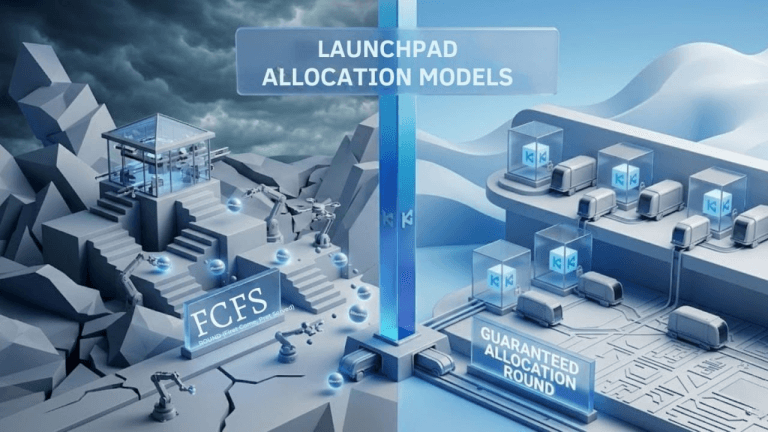
Two models dominate the launchpad landscape today: First Come, First Serve (FCFS) and Guaranteed Allocation. On the surface, they sound simple. In practice, they produce very different outcomes depending on who you are, how much capital you have, and how fast your internet connection is. Understanding the difference isn't just academic — it's the difference between getting in on the ground floor and watching others celebrate 10x gains while you're stuck refreshing your browser.
Let's break it all down.
What Is the FCFS Allocation Model?
First Come, First Serve (FCFS) is exactly what it sounds like: tokens go to whoever shows up and transacts first. When the sale opens, the clock starts. Investors race to submit their purchases, and once the pool is empty, it's over. No queue, no priority, no sympathy.
FCFS gained early popularity because of its apparent simplicity and democratic feel. There are no complicated tier calculations, no lengthy staking periods to game, and no whitelists to navigate. In theory, anyone can participate — you just need to be ready when the bell rings.
How FCFS Works in Practice
In a typical FCFS round:
- The token sale opens at a fixed time (often announced days in advance)
- Investors connect their wallets and submit purchase transactions simultaneously
- Blockchain transaction speed, gas fees, and server load determine who gets through
- The pool sells out — sometimes in seconds, sometimes in minutes — and latecomers get nothing
Some platforms have modified FCFS to reduce pure speed advantages. For instance, certain launchpads eliminate "gas wars" (where investors overpay network fees to jump the queue) by using off-chain transaction queuing or randomized ordering within a short window. But the core principle remains: timing is everything.
The Real Strengths of FCFS
Open access. FCFS rounds typically require little to no staking commitment, which means even investors with minimal capital can theoretically participate. This is why many platforms reserve FCFS as a secondary round — open to the public after stakers have had their turn.
Low barrier to entry. On platforms that combine guaranteed rounds with an FCFS overflow, the FCFS portion captures remaining unsold tokens and makes them available to a wider audience, including non-stakers.
Speed-driven meritocracy. If you're well-prepared — right wallet, right network, right setup — FCFS rewards action and readiness.
The Critical Weaknesses You Can't Ignore
Here's what the marketing doesn't always say: FCFS in its purest form overwhelmingly favors bots, wealthy investors using multiple wallets, and technically sophisticated actors. When a high-demand IDO opens and thousands of investors hit the smart contract at the same second, individual retail investors are structurally disadvantaged.
Practically speaking:
- Bots dominate. Automated scripts can submit transactions microseconds after the sale opens, leaving human investors watching.
- Network congestion spikes. High-demand sales create gas fee surges that effectively price out smaller investors.
- Outcome is unpredictable. You can do everything right — research the project, prepare your wallet, be online at the exact moment — and still miss out through no fault of your own.
- Stress and frustration. The adrenaline-fueled "race" model burns out investors and damages community trust when the same insiders win every round.
As one honest assessment noted, FCFS can diminish a project's perceived value precisely because it reduces participation requirements — and it can leave small-to-mid-sized investors perpetually locked out of the best deals.
What Is the Guaranteed Allocation Model?
Guaranteed allocation turns the entire paradigm around. Instead of rewarding speed, it rewards commitment. Investors who stake the platform's native token over a defined period receive a pre-calculated allocation that is reserved for them — no racing, no bots, no luck required.
The core promise is exactly what it says: your spot is guaranteed. You know before the sale opens how much you can invest, and that allocation is yours to claim within the sale window.
How Guaranteed Allocation Works
The mechanics vary by platform, but the general flow looks like this:
- Investor stakes the launchpad's native token for a set period before the sale
- Allocation is calculated based on the proportion of staked tokens relative to the total pool
- During the sale window, the investor claims their reserved allocation at their convenience
- Any unclaimed or unsold tokens may roll over into an FCFS or community round
The key word is proportional. On well-designed platforms, the more you stake, the more you get — but crucially, smaller stakers also receive allocations proportional to their contribution. This is what separates a genuine guaranteed system from a tiered system that merely labels its top tier as "guaranteed" while everyone below rolls the dice.
Why Guaranteed Allocation Is a Game-Changer for Most Investors
Predictability. You can plan your investment before the sale even opens. No last-minute scrambling, no gas fee surprises, no failed transactions. You know your allocation size in advance.
Accessibility. When guaranteed allocation is tied to proportional staking — not arbitrary tier minimums — even investors with modest holdings participate meaningfully. This levels a playing field that FCFS consistently tilts toward the powerful.
Community alignment. Staking creates long-term alignment between investors and the launchpad ecosystem. Investors who commit tokens for weeks or months are more likely to be serious, research-driven participants — not flippers looking to dump immediately post-launch.
Reduced manipulation. Without a speed race, bots offer no advantage. The allocation is calculated on-chain before the sale, making it resistant to gaming.
Head-to-Head: FCFS vs. Guaranteed Allocation
Factor | FCFS | Guaranteed Allocation |
Access requirement | Speed + timing | Staking + commitment |
Predictability | Very low | Very high |
Bot resistance | Low | High |
Fairness for retail investors | Low to moderate | Moderate to high |
Capital required | Minimal (often none) | Proportional to staking |
Stress level | Very high | Low |
Ideal for | Quick participants, non-stakers | Long-term holders, planners |
Allocation size control | None | Proportional to stake |
Best round position | Secondary/overflow | Primary round |
The table tells a clear story: FCFS is best understood as a secondary mechanism — useful for distributing unsold tokens to a broader audience — while guaranteed allocation is the primary model that actually serves committed investors well.
Most sophisticated launchpads have figured this out. The industry has converged on a hybrid approach where guaranteed allocations are offered first to committed stakers, followed by an FCFS round for any remaining tokens open to the wider community.
The Tier Problem: When "Guaranteed" Isn't Really Guaranteed
Here's where it gets nuanced — and where many investors get burned.
On tiered launchpad platforms, "guaranteed allocation" often means something very different from what it implies. Top-tier stakers (usually requiring thousands of dollars worth of the platform's native token) receive guaranteed allocations. Everyone below them enters a lottery — and in a lottery, you can stake diligently for months and still walk away with nothing.
This creates a practical divide:
- Whale tier: Guaranteed access, large allocations, exclusive private rounds
- Mid tier: Lottery-based, inconsistent outcomes
- Low tier: Minimal lottery chances, often locked out of the best deals
- No tier: Relegated to public FCFS rounds or excluded entirely
The capital required to reach guaranteed tiers on major platforms is substantial. Reaching a guaranteed allocation bracket on some popular launchpads requires staking tokens worth anywhere from hundreds to thousands of dollars — a realistic entry point for institutional players, but a wall for emerging retail investors.
This is the fundamental equity problem that traditional tiered systems create: they promise democratized access to early-stage investments, then gatekeep that access with capital thresholds that exclude the very community they claim to serve.
How Kommunitas Solves the Problem: Tierless Guaranteed Allocation
Kommunitas tackles this head-on with its Kommunitas's tierless launchpad, which replaces tier games with proportional, guaranteed allocation.
This is where Kommunitas takes a genuinely different approach — and why it matters for investors at every level.
Kommunitas was built on the conviction that a launchpad should serve its community, not just its wealthiest members. The platform operates a tierless system, meaning there are no hierarchical brackets, no lottery for lower-level participants, and no capital threshold that determines whether you get a guaranteed spot or not.
Here's what that looks like in practice:
- Every KOM staker receives a guaranteed allocation, proportional to the amount of KOM they stake. Stake more, get more — but everyone gets something.
- The minimum is genuinely accessible. With a minimum of just 100 KOM to participate, the barrier is among the lowest in the industry.
- No gaming the system. Because allocations are calculated proportionally across all participating stakers before the sale, there's no deadline optimization, no last-minute staking rushes, and no gas war.
- FCFS plays its proper role. On Kommunitas, FCFS exists as a secondary round — specifically for unsold tokens from the Booster rounds. It's open to all KOM stakers and carries a transparent, non-refundable fee. This keeps FCFS where it belongs: as an overflow valve, not the primary access mechanism.
- Community Round for everyone. After the FCFS round, a Community Round opens even to non-KOM holders, allowing the broadest possible participation in the ecosystem.
The structure of a typical Kommunitas IKO (Initial KOMmunity Offering) looks like this:
Booster 1 → Guaranteed allocation for active KOM stakers who voted (minimum 3,000 KOM to vote) Booster 2 → Guaranteed allocation for KOM stakers who didn't vote but are still staked FCFS Round → Open to all KOM stakers (minimum 100 KOM), for unsold tokens from Boosters 1 & 2 Community Round → Open to everyone, including non-KOM holders, until the target is reached or 48 hours before listing
This waterfall structure is elegant because it rewards the most committed community members first, then progressively opens access to wider audiences — without ever making any participating staker feel like they're gambling.
Practical Guide: Which Model Should You Prioritize?
Understanding the models is one thing. Knowing how to position yourself is another. Here's a practical decision framework:
If you're a new crypto investor: Avoid pure FCFS rounds as your primary strategy. The competition is fierce and the outcome is unpredictable. Instead, start small — accumulate a modest staking position on a tierless guaranteed platform like Kommunitas, where even a small stake earns you a proportional seat at the table.
If you're a mid-level investor with moderate capital: Guaranteed allocation on a tierless platform is your best friend. You get predictable access, eliminate lottery stress, and can plan your portfolio entries in advance. Look for platforms where your allocation scales proportionally with your stake — not ones where you need to hit an arbitrary threshold just to avoid the lottery.
If you're an experienced or high-capital investor: Evaluate both models. On hybrid platforms, FCFS overflow rounds can offer additional allocation beyond your guaranteed share. On Kommunitas specifically, Private Partners (500,000+ KOM staked) gain access to private and seed rounds, plus quarterly revenue sharing from FCFS and Community Round fees — a meaningful passive income stream on top of IDO allocations.
For everyone: Time your stake strategically. Most launchpads require staking before a snapshot or voting deadline. On Kommunitas, the proportional system means there's no mad rush in the final 48 hours before snapshots — your stake simply counts for as long as it's in.
Key Takeaways
- FCFS is fast, open, and often dominated by bots and well-capitalized actors — best used as a secondary overflow mechanism, not a primary allocation tool.
- Guaranteed allocation rewards commitment over speed, is far more predictable, and is resistant to bot manipulation — making it the superior model for serious investors.
- Tiered "guaranteed" systems aren't truly egalitarian — they often impose capital thresholds that recreate the same exclusion problem they claim to solve, with lotteries for mid-tier participants.
- Kommunitas's tierless guaranteed model is the most inclusive implementation of guaranteed allocation in the space: every staker participates proportionally, with no arbitrary tier walls and no lottery stress.
- A hybrid round structure — guaranteed → FCFS → community — is the gold standard, and it's exactly how Kommunitas operates.
FAQ
Q: Can I participate in a Kommunitas IDO if I only hold a small amount of KOM? Yes. With as little as 100 KOM staked, you can participate in the FCFS round. To participate in the primary Booster 1 guaranteed round and vote for projects, you'll need at least 3,000 KOM staked. The allocation you receive scales proportionally with how much KOM you stake — there's no minimum that locks you out of the entire system.
Q: Is FCFS always a bad model for investors? Not entirely. FCFS works well as a secondary mechanism for distributing unsold tokens after guaranteed rounds have closed. It creates an open, accessible overflow opportunity without disrupting the primary allocation structure. The problem arises when FCFS is used as the primary allocation method, where it disproportionately rewards bots and technically equipped heavy investors.
Q: What's the difference between a lottery system and FCFS? A lottery assigns random chances to participants, usually weighted by how much they stake. FCFS assigns allocation based purely on transaction speed. Both are less reliable and less investor-friendly than guaranteed proportional allocation — but they serve different secondary purposes. Kommunitas uses neither as its primary mechanism.
Q: What happens if I forget to vote in a Kommunitas IKO? If you're staked but forget to vote before the voting deadline, you'll miss Booster 1 but can still participate in Booster 2 — which covers unsold tokens from the first round. After Booster 2, the FCFS round is open to all stakers. Missing a vote means a smaller potential allocation, but you're not completely locked out.
Q: Why does Kommunitas charge a fee on FCFS and Community Rounds? The non-refundable fees on FCFS (3%) and Community Round (10%) serve two purposes: they filter for serious participants (reducing spam and casual flippers) and generate revenue that is shared with Private Partners quarterly. This creates a sustainable economic loop that rewards the platform's most committed long-term community members.
Conclusion: Choose the Model That Works for You — Not Against You
The allocation model a launchpad uses isn't a minor technical detail. It's a declaration of values — a statement about who the platform was built for and what kind of investor it rewards.
FCFS rewards speed and technical infrastructure. Traditional tiered guaranteed systems reward capital above all else. But Kommunitas's tierless guaranteed allocation model rewards something different: commitment and community participation, at every capital level.
Whether you're putting in $10 worth of KOM or $10,000, you receive a proportional, guaranteed allocation — no lottery tickets, no bots, no stress. The FCFS and Community Rounds then serve their proper role: extending opportunity outward to the broader ecosystem, not serving as the only door for retail investors to squeeze through.
If you've been frustrated by missed IDOs, failed FCFS transactions, or lottery losses on other platforms, the solution isn't to give up on early-stage crypto investments. It's to choose a platform where the mechanics are built in your favor.
Ready to participate in your first guaranteed IDO? Visit kommunitas.net, stake your KOM, and secure your proportional allocation in the next IKO — no tier required, no race to win.
Related Reading
References
- How the Allocation System Works in Crypto Launchpad Tiers — Kommunitas Blog (kommunitas.net/blog/crypto-launchpad-tiers-allocation)
- Kommunitas Launchpad FAQ — Kommunitas Official Documentation (docs.kommunitas.net/faqs/launchpad-faq)
- Crypto Launchpads Capital Requirements Comparison 2026 — Kommunitas Blog (kommunitas.net/blog/crypto-launchpads-capital-requirements-comparison)
- Kommunitas: The Platform Break Through Identification Limitations — CryptoRank.io (cryptorank.io/news/feed/d3cfd-189154-kommunitas-break-identification-limitations)
- Best Crypto Launchpads & IDO Platforms in 2025: Expert Reviews — Blockpit Blog (blockpit.io/blog/crypto-launchpads)
- 11 Best IDO Launchpad Platforms in 2025 — CoinCodex (coincodex.com/article/49695/best-ido-launchpad-platforms)
- What is a Launchpad? Common Crypto Launchpad Models — Plisio (plisio.net/blog/what-is-a-launchpad)
- Everything You Need to Know About Token Launchpads — Technollogy (technollogy.com/2025/07/everything-you-need-to-know-about-token)
- Kommunitas — Decentralized Launchpad for Early-Stage Token Access — CryptoRank.io (cryptorank.io/fundraising-platforms/kommunitas)
- Top IDO Launchpads to Explore in 2024 — KuCoin Learn (kucoin.com/learn/web3/top-ido-launchpads)